
What is one thing that all companies have but nobody uses? That’s right, a mission statement. The reason why nobody uses them is that most of them are written very badly. Today, we are going to tackle the world’s mission statement problem.
Understanding What a Mission Statement Really Is
First, let’s start with the definition of a mission statement. No company is built solely to make money. There is always something greater than that. Your company exists because you address certain human needs, and by satisfying those needs you hope to improve the world around you. That perfect future is your vision. No company can build that future alone, but your company plays a key role in shaping the perfect picture. And that role is your mission.
Focus on Potential, Not Aspirations
Second, forget “what you want to be” and instead focus your energy on “what you can become.” Define your role broadly yet realistically. Defining broadly will give you an audacious goal, while defining realistically will make sure that you stay on the right track. This balance between ambition and practicality creates a mission that inspires without overwhelming.
Keep Money Out of Your Mission
Third, do not even consider writing your financial goals. The worst mission statements talk about ROI’s and financial targets. Keep in mind that the primary audience of your mission statement is your employees, who want to make a meaningful difference in people’s lives. When you lead with financial metrics, you strip away the emotional connection that makes work meaningful.
Avoid the Trap of Generic Language
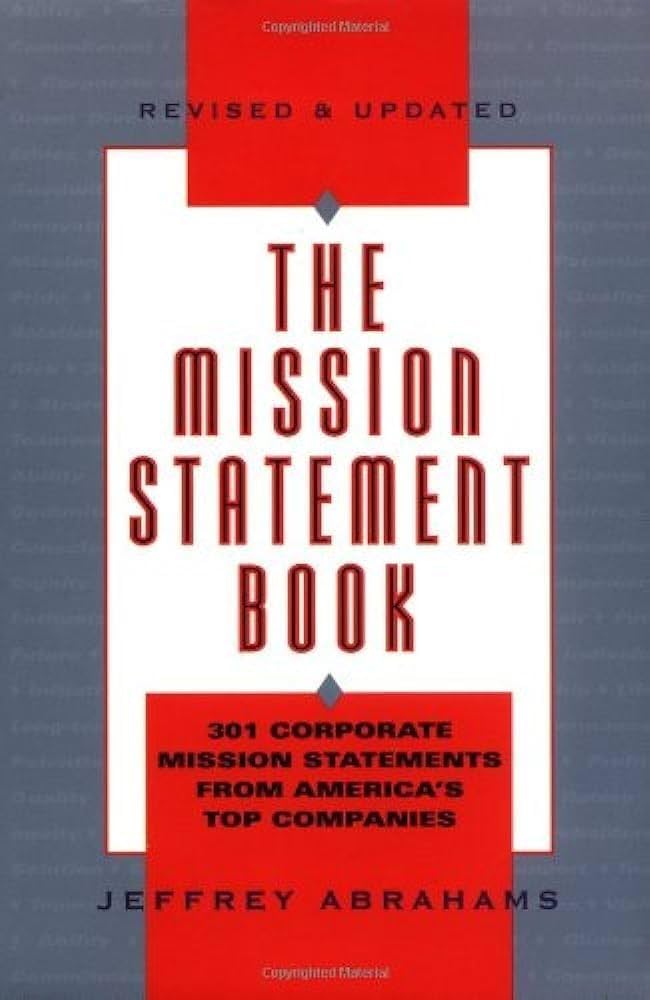
Fourth, avoid clichés at all costs. The Mission Statement Book examined 301 American companies and found that service appeared 230 times, customer 211 times, quality 194 times, value 183 times, and employees 157 times. Try to explain your mission by using authentic, memorable, and motivating words that reflect your unique contribution to the world. Generic language creates generic commitment.
Make It a Leadership Priority
Fifth, make sure your CEO is involved. This is a task for senior management, not the marketing department. When leadership owns the mission, it carries weight throughout the organization. A mission statement crafted by committee or delegated to communications teams rarely resonates with the authenticity employees crave.
Bring Your Mission to Life
Finally, hanging the statement on the wall is not enough. Run internal seminars and town halls to educate your team about what the mission means in practice. Make sure that your employees ask questions about how their daily work connects to the larger purpose. That engagement is a good indicator that they are willing to accept and embody your mission statement.
Today’s Actionable Tip
This insight comes from Mary J. Braide: People might have a different understanding of what constitutes a mission statement. Therefore, always write a clear description of the mission statement’s purpose, such as “Our role in building the perfect future,” directly before your actual mission statement. This context helps everyone understand exactly what they’re reading and why it matters.
In my next post, I will share some mission statements that truly inspire and motivate. In the meantime, I’d love to hear from you: what are some examples of mission statements that resonate with you and why do they work?
Nice post with conceptual clarity. Mission statement is the company’s identity and the image it wants to project to all its stakeholders including employees.
Thanks and regards!
Thank you very much Dilipnaidu. I agree with your remarks on mission statement being a company’s desired image. Please feel free to demand me to write on any subject.
Cheers,
Gunter