
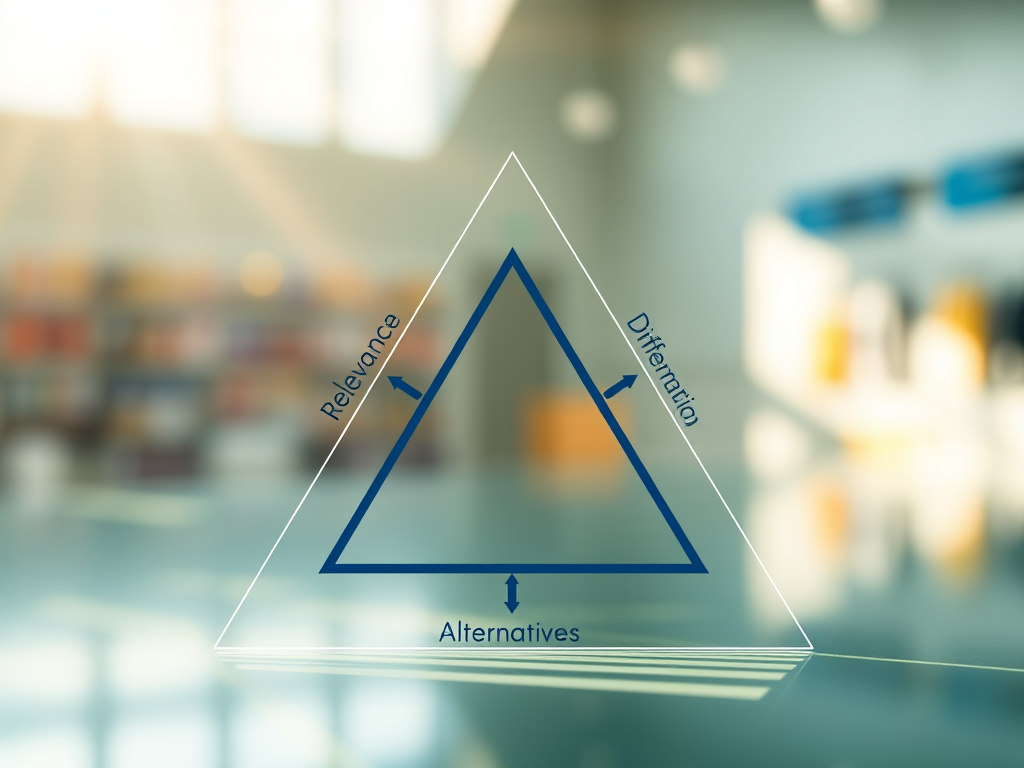
My nine-year-old son was struggling with a math concept about triangles and required some assistance. We sat down together, and as I refreshed my Euclidean geometry knowledge to help him, I was reminded of a graphic I often use to illustrate brand strategy to my clients: a triangle that represents your brand, your customers, and your competition. Just as geometry focuses on relationships and balance, branding does too.
For a brand to thrive, it must maintain three essential connections: relevance to its customers, differentiation from its competition, and an awareness of alternatives—how customers perceive its competitors.

Your Market Position Defines Your Brand Strategy
Helping my son visualize the properties of triangles gave me a fresh perspective: different brands, like different triangles, require unique strategies depending on how they balance these connections. Each side of the triangle represents the strength of a relationship:
- Relevance is the closeness between your brand and your customers’ needs and emotions.
- Differentiation is how distinctly your brand stands apart from the competition.
- And Alternatives represent how tempted your customers are by competitors. The challenge is managing these dynamics, just as you balance the sides of a triangle.
Reflecting on these rules made me realize that each brand finds itself in a unique strategic situation. No two triangles are the same, just as no two brands face the same dynamics. The relationships between relevance, differentiation, and alternatives can shift in ways that require a tailored approach. Some brands need to focus on building stronger connections with their customers, while others need to stand out more clearly from the competition. And sometimes, it’s about making competitors look less attractive altogether.
Here are eight common scenarios that illustrate how brands might navigate these relationships:
1. The Dream Scenario (Short Relevance + Long Differentiation + Long Alternatives)
This is the ideal scenario where your brand is the clear leader. You are highly relevant to your audience, uniquely differentiated, and your competitors aren’t compelling enough to pose a real threat. Think of brands like Apple or Amazon—they deeply connect with their customers by providing what they need in a way that stands out from everyone else. Even though competitors exist, there’s simply no better alternative for loyal customers.

If you’re in this scenario, the challenge is maintaining that leadership through continuous innovation and ensuring you remain relevant as market needs evolve. This requires always listening to your customers and finding new ways to improve their experience while keeping competitors at bay.
2. The Competitor in the Crosshairs (Short Relevance+ Long Differentiation+ Short Alternatives)
In this scenario, your brand is both relevant to your customers and well-differentiated, but competitors remain attractive alternatives. This is the case for Spotify—it connects well with its users but faces strong competition from Apple Music and YouTube Music.

If this is your case, then your task is to increase the perceived gap between you and competitors by reinforcing your unique value and potentially offering additional benefits that further secure your position. The key is to make it harder for customers to be tempted by competitors.
3. The Safe Bet (Short Relevance+ Short Differentiation+ Long Alternatives)
A brand that is relevant and liked by its customers but doesn’t offer much that sets it apart from competitors. Still, the competition isn’t seen as significantly better, which works in the brand’s favor. Starbucks, for example, has strong customer loyalty, even though its offerings aren’t wildly different from other coffee chains anymore. Competitors like Dunkin’ exist, but Starbucks remains the top choice for loyal customers.

Interestingly, many utility providers (electricity, gas, or water) operate in monopolistic environments, and state-owned airlines also fall into this category. These brands are relevant because people need them, but they often lack differentiation, and alternative options are restricted.
If you find yourself in this situation, complacency is your greatest enemy. To avoid stagnation, you need to deepen your differentiation—just like Starbucks did back then by creating a sense of community in their stores and emphasizing ethically sourced coffee.
4. The Fool’s Gold (Long Relevance+ Long Differentiation+ Short Alternatives)
This is a good news, bad news type of situation. You have a differentiated brand but are not relevant enough to customers. Despite offering something unique, customers aren’t connecting with it, and the competition remains more appealing. A good example is Patagonia Provisions. While Patagonia is a well-respected brand with a strong identity, its food division has struggled to gain the same relevance, with customers opting for other, better-established organic or natural foods that offer similar benefits at lower prices.

In this situation, you need to focus on strengthening your relevance by better aligning your differentiated offering with what customers truly value. Make your unique features more meaningful to their lives.
5. The Disconnected Innovator (Long Relevance+ Long Differentiation+ Long Alternatives)
This is a tricky scenario—your brand is highly differentiated from competitors, but it’s failing to be relevant to its customers, and surprisingly, competitors aren’t attractive either.
Essentially, you’ve created a distinct offering, but customers don’t see how it fits their needs, and the rest of the market isn’t doing much better. You stand apart, but that doesn’t necessarily mean you stand out in a meaningful way for customers.

This was the case with Segway, the futuristic transport device, that Steve Jobs claimed to be the most innovative piece of technology since the personal computer. But people never fully understood where it fit into their lives. At the same time, there wasn’t any major competitor offering an attractive alternative—people simply stuck with walking or cycling.
6. The Competitive Stalemate (Short Relevance+ Short Differentiation+ Short Alternatives)
This is a crowded and stale market where no brand, including yours, is offering much that stands out. Fast food chainslike McDonald’s and Burger King are locked in this stalemate. Both brands are relevant for their quick, affordable meals, but they don’t offer much in terms of differentiation, leading to constant price and promotion battles for market share.

If you’re here, the goal is to break out of the cycle by finding a way to meaningfully differentiate your brand. This could be through unique customer experiences, healthier options, or tapping into trends like sustainability.
7. The No-Man’s Land (Long Relevance+ Short Differentiation+ Long Alternatives)
Finally, in this scenario, the entire market is failing to meet customer needs. Neither your brand nor the competition is connecting with customers (low relevance), and there’s little to differentiate anyone. This was Kodak when digital cameras emerged—neither Kodak nor its competitors were doing enough to engage the new wave of customers, leaving the market wide open for a disruptor like Apple with the iPhone.

This is a market ripe for disruption. Customers are dissatisfied, and there’s a vacuum waiting to be filled. The goal here is to innovate and create something that makes both your brand and the competition irrelevant.
8. The Bermuda Triangle (Long Relevance+ Short Differentiation+ Short Alternatives)
This is the terrain of death. Your brand struggles to connect with customers (low relevance), isn’t differentiated, and competitors are equally compelling.
This was BlackBerry in its final years, or Nokia during its smartphone era. They lost relevance as their competitors (like Apple and Android) introduced better, more advanced products. Despite having a foothold in the market, these brands didn’t stand out enough and were outmatched by more innovative competitors.

To avoid this scenario, your focus must be on reestablishing relevance by understanding evolving customer needs and finding ways to offer something new or different that resonates more effectively.
Shape Your Strategy to Fit Your Brand
Just like in life, no two brands are the same. Each one has its own set of challenges, opportunities, and positioning. As we’ve explored through these eight scenarios, there’s no one-size-fits-all strategy. The real task is understanding where your brand currently stands in terms of relevance, differentiation, and the alternatives your audience might consider. From there, you can make the thoughtful adjustments needed to shift or strengthen your position.
Brand strategy, at its core, is about adaptability. It’s not about rigid formulas or checklists. Instead, it’s about crafting a strategy that fits the unique shape of your brand, market, and customers. Whether you’re competing in a saturated space or breaking new ground, the goal is always to ensure your brand remains relevant, distinct, and ahead of the competition.
What worked for Apple, or how Spotify stayed ahead, might not work for your brand—and that’s the beauty of branding. It’s a nuanced, flexible discipline that demands custom solutions, not cookie-cutter answers.
So, Where Does Your Brand Stand?
If you’re reflecting on where your brand fits within this triangle of relevance, differentiation, and alternatives, now might be the perfect time to take a closer look. Understanding your position is the first step toward crafting a strategy that resonates deeply with your customers and sets you apart from the competition.
I’d love to hear your perspective—where does your brand sit in this triangle right now? Are you confidently in your sweet spot, or are you looking for ways to deepen your relevance or stand out even more? Let’s keep the conversation going.
Feel free to share your experiences in the comments or repost this article if you think your network would appreciate this approach. Every brand’s path is different, and I’m always curious to hear how others navigate these unique dynamics.