

Back then, I was collaborating with a renowned agency on a re-branding project. Upon completing nationwide research, we started working on brand personality, one of the building blocks of brand strategy.
At that point, the agency’s creative director adamantly insisted that the brand should opt for a humorous tone of voice—an idea that did not resonate with me. After all, neither the research nor the competitive audit pointed in such a direction.
So, why were the creatives so hell-bent on using humour? Was that the right tone of voice for the brand? If we were to use humour, how funny should the brand be?
With all those questions, I decided to review the agency’s portfolio. Unsurprisingly, they used the same type of humor in most of their work, from clothing to food, telecommunications, and fitness centers.
Was the sole and exclusive use of humour an example of Maslow’s Hammer? (Treating everything as if it were a nail when you have a hammer.) Or did the creative team get possessed by an old habit that prevented them from opening a new door? Or was humor just a cop-out for the agency, which didn’t want to dig deeper to discover another way of communicating?
Was the sole and exclusive use of humour an example of Maslow’s Hammer?
Whatever the case, I knew the creatives were not right, but back then, I didn’t have the facts to defend my point of view. In the absence of factual information, people with the loudest voice often win. That’s precisely what happened.
Fast forward to today. The brand has taken a nosedive, losing 95% of its stock value.
Granted, the erroneous tone of voice was just one of the many reasons that contributed to the brand’s demise. Nevertheless, it was clear that using humour—where it was not needed—was a contributing factor. Consequently, I began a fact-finding journey about when and how to use humour in brand communications.
As you can see, the title of this article has a double meaning. First, it refers to the extent or degree of the use of humour. In short, should you dial up or down your funniness?
But there is also the way or manner you should use humour. So, which type of humour is appropriate to your audience? Let’s go!
The use of humour in ads is universal – its impact isn’t.
Creatives around the world invoke humour, which is a common element in advertising. That said, a Millward Brown study shows that North American advertisers resort to humour more often than their colleagues worldwide. So, while fun in ads is universal, the frequency with which it is used is higher in North America. The obvious question is, why?

Westerners believe that funny ads tend to be more impactful. For example, a survey reveals that 94 percent of research and creative directors in U.S. advertising agencies think fun is effective at gaining attention. In short, humor creates a high awareness among European and North American viewers, who want to laugh when they see or hear an advertisement.
“Funny ads are more memorable” is a reasonably ethnocentric statement.
That impact, however, almost disappears in other geographies. That’s why “funny ads are more memorable” is a fairly ethnocentric statement. Humour does not make an ad universally more memorable.

Does humour persuade?
Humorous ads are likely remembered in the Western world. But are they more persuasive?
If your objective is to entertain the viewer and get them involved and engaged with the brand, then the use of humour is an effective tactic. However, if you need to persuade your audience, you must know this: Humour does not boost persuasion, for humorous ads are seen as less credible and relevant.
Humour does not boost persuasion because humorous ads are seen as less credible and relevant.
Also, humour impedes the transfer of new information. If you need to educate the viewer about something new (e.g., a new ingredient, a new formula), you are better off staying away from humour.

To whom does the humour serve?
As the famous saying goes, “Half the money you spend on advertising is wasted; the trouble is you don’t know which half.” We might have a clue.
Humour works best when it is related to the product. Where branding is weak, the ad entertains the viewer. But it neither advances the brand’s message nor adds to its equity. In such cases, humour becomes a self-serving concept. So, while humour matters, what matters even more is the brand-centric delivery of it.
“Half the money you spend on advertising is wasted; the trouble is you don’t know which half.” We might have a clue.
Laughing is universal. What makes us laugh isn’t.
Anyone who has interacted with a foreigner would know that jokes are culture-specific, for humour is embedded in language and culture. In the absence of shared knowledge, humour does not function.
For instance, BBC Culture asked movie critics worldwide to rank their favourite comedies of all time. The votes varied drastically from country to country and from region to region. The study states that “silent cinema is particularly popular with Asians. The French are into Jerry Lewis and Woody Allen; Brits love to keep their quips dry; Australians like to dive headlong into the bawdy, and Indians prefer keeping their jokes jolly.”
Humour is also gender-specific. Men and women perceive humour differently. There is quite a bit of difference in response to humour between men and women. Generally, while men hold fun in high regard, women tend to notice the dark side of jokes.
Generally, while men hold fun in high regard, women tend to notice the dark side of jokes.
That, however, doesn’t mean that women think humour matters less. On the contrary, research shows that globally, women find humour as important as men (49 percent vs 46 percent.) The same study tells us that far fewer ads featuring women try to be funny. While 51 percent of global ads featuring men use humour, this is true of just 22 percent of ads featuring women, which might have something to do with the fact that advertising is still a boys’ club.
Humour style depends on the personality of the viewer.
We said humour is culture and gender-specific. But above it, all, humor is highly subjective. What is funny to you might not be funny to your cousin. And that’s where psychometrics come into play.
What is funny to you might not be funny to your cousin. And that’s where psychometrics come into play.
At the heart of advertising lies demographics. “Our target audience is a Caucasian male, between the ages of 25-45, living on the West Coast,” says one ad brief. Based on your income, race, and age- you and -let’s say- your cousin might have an identical profile. The problem is, while you are similar on the surface, your personality and your cousin’s might be galaxies apart.
For instance, you might like upbeat music, he eclectic, sophisticated jazz. You might prefer going on shopping trips or sailing. When making product purchases, you might be influenced by family, he not so much.
All those things are predictable thanks to the Big Five (OCEAN) personality traits, which can reveal much information about one’s lifestyle and behaviors. Your personality could forecast the success of your marriage, academic performance, achievements at work, or political tendencies with surprisingly high accuracy.
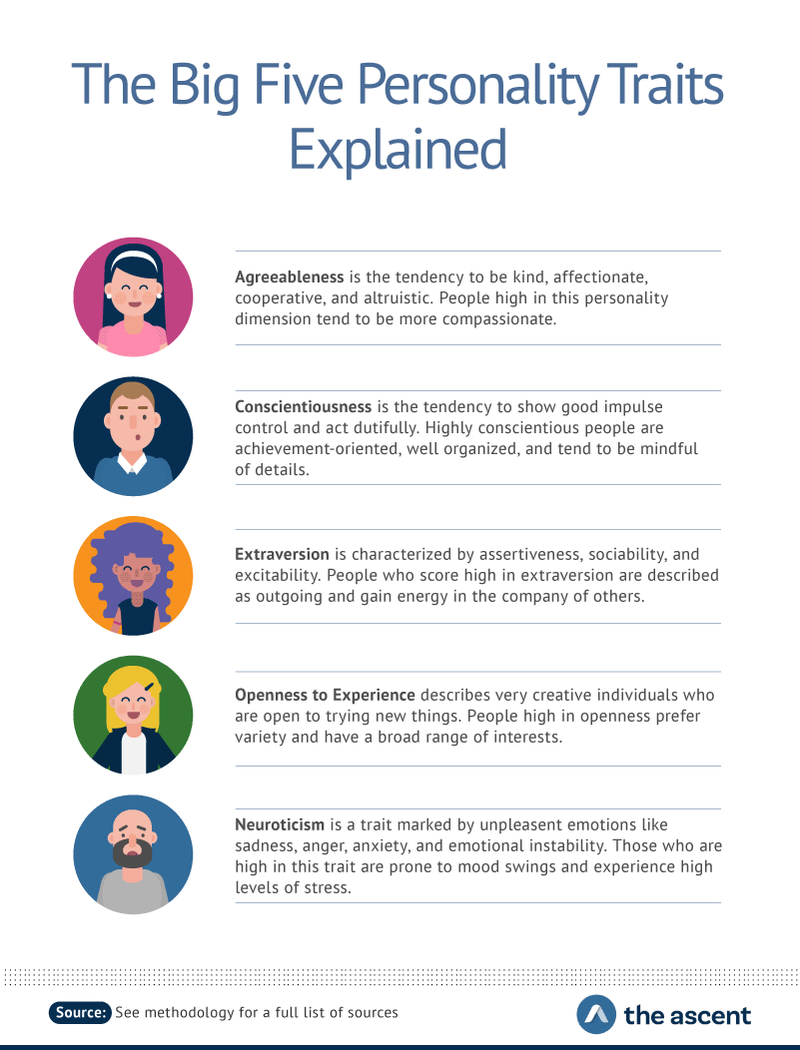
Personality traits could also predict what kind of communication might appeal to you. For instance, extraverts have a favourable attitude toward transformational ads. They also love going to the movie theatre, but they do not like watching TV as much. Highly conscientious people, on the other hand, are sensitive to brands that boost their prestige and self-confidence. Furthermore, they are more likely to be persuaded by a comparative ad.
Personality traits could also predict what kind of communication might appeal to you.
Scientific literature shows that there is a relationship between humour and personality. To put it briefly, the personality of your target audience determines how you should use humour. Let’s dig a bit deeper.
Four kinds of humour
To categorize the types of humour, we can imagine a 2×2 matrix. The horizontal axis is about the focus of the humour. Interpersonal humour enhances one’s relations with others. Intrapersonal humour, on the other hand, focuses on the self and acts as a form of mental protection.
The vertical axis is about the content of the humour. Benign one is constructive, whereas malign one is destructive.
Using these two criteria, we can identify four distinct categories. Affiliative humour (interpersonal/benign) is about telling jokes and stories to relate to others and improve relationships.
Self-enhancing humour (intrapersonal/benign) involves laughing at life’s idiosyncrasies, which allows us to distance ourselves from stressful problems.
Aggressive humour (interpersonal/malign) involves sarcasm, ridicule, and irony, and it helps one manipulate, threaten, and possibly control others.
Finally, there is self-defeating humor (intrapersonal/malign), which is allowing oneself to be the “butt of the joke” to get attention from others. It is a type of defensive denial whereby people hide their negative feelings and avoid facing up to rejected aspects of their personality.

The question is -if your brand will have a funny tone of voice- which type of humour should you choose? Usually, that decision is made in a rather intuitive way. However, it doesn’t have to be that way.
Personality meets humour
We know that enthusiastic and assertive people prefer benign humour. Also, intellectual and open-minded people prefer self-enhancing humour. People that possess volatile and withdrawal personality traits, however, are primed for self-defeating humour. On the other hand, the absence of those traits makes self-enhancing humour more desirable. Likewise, compassion and politeness indicate whether one would prefer affiliative or aggressive humour.
With those insights, let’s revisit you and your imaginary cousin.
Based on his profile, your cousin might prefer self-defeating humour. (high on openness to experience and extraversion, and medium on neuroticism.)
In contrast, you might respond more positively to affiliate humour. (high on agreeableness and extraversion, and medium on openness to experience.)
To reiterate, humour is both gender and culture-specific. As per gender differences, around the world, women tend to be somewhat higher than men in neuroticism, extraversion, agreeableness, and conscientiousness. So, right of the bat, that eliminates the use of self-enhancing humour when communicating to women -unless you know that your target audience is asking for it. Affiliative humour might be a better fit.
Women are categorically less open to self-enhancing humour, whereas they are more open to affiliative humour.
On the cultural side, let us pick two countries thousands of miles apart: Brazil and Turkey. Data shows Brazilians (as a whole) are lower in extraversion, openness to experience, and agreeableness than Turks. They also score higher in neuroticism. That tells us that -culturally- Brazilians might be more open to malign humour than Turks, who are more likely to be offended by it.
Actionable insights
Even if you have access to comprehensive data -which nobody does- you can not predict human behaviour with 100% accuracy.
That said, by combining advertising research and psychometric knowledge, creatives and strategists could make more educated guesses about the degree and how they should use of humour.
So, before we sum it up, let’s review five rules of thumb.
1. Use humour if your target audience likes you
As mentioned above, humour diminishes persuasiveness, especially when you need to say something new. Moreover, if your target audience has a non-favourable attitude towards your brand, then humour becomes riskier.
So, as a rule of thumb, if (a) your target audience favours your brand, (b) you are not communicating new information, then (c) you don’t need to convince them to buy your product, then you can feel more comfortable using humour.
2. Use humour if you want to gain attention, not comprehension.
We live in the -what’s called- Attention Economy. Communication specialists state that people’s attention is a scarce resource. That’s why, according to the traditional model called AIDA (Attention, Interest, Desire, and Action), a brand’s primary communication task should be to grab people’s attention. That’s where jokes and wit come into play.
Humour, indeed, enhances attention. In a sea of sameness, it helps your message to stand up. That gain in attention, however, comes at a cost. Funny ads distract viewers, suppressing their cognition -especially the critical type. When that happens, people face difficulty processing the central benefit of the brand. As a result, people remember the joke yet forget the product.
As a rule of thumb, could you try to remove the product from the ad? If the ad is not funny anymore, it means that humour positively affects the viewer’s cognition. If the ad is still funny, you are trading attention for comprehension.
3. Use humour if you advertise a low-involvement product
In line with the previous point, high-involvement products require higher cognitive effort. According to Adam Alter, a psychologist and professor at New York’s Stern School of Business, ‘people associate more complexity with luxury products and so disfluency, or cognitive difficulty, makes luxury products more appealing.’
That’s why humour works more effectively for low-involvement products, especially if it is a hedonic product. According to a study that took place in the UK and the US, humour was used nearly half the time for low-involvement hedonic products, but in only one in seven instances for high-involvement hedonic products. And when humour was used in high-involvement products, it was more effective when it was relevant to a simple argument.
4. Use humour when your message is viewed in public
We can imagine humour as a kind of social lubricant. Some even claim that there is a biological reason for humour. For that reason, humour is more effective when viewed in the presence of others – such as when we are a movie theatre or watching the Super Bowl.
That makes sense. According to the Big Five personality model, people who score high in extraversion tend to be more merry and cheerful. Moreover, as discussed above, they are more likely to prefer a social experience such as watching a movie at the theatre to watching TV alone.
So, if your audience is more likely to see your message in the presence of others, then you can feel more comfortable using humour. If, on the other hand, they will see it alone -and cannot immediately share it with others, then a more severe approach might be more appropriate.
5. Use humour if you are facing a behavioural barrier
Some communication challenges are hard to overcome. For instance, how do you convince people to stop smoking, use less energy, or exercise more often? For each one of those tasks, there is a behavioural barrier, which makes people more resistant to your message.
In such cases, humour might be a useful tactic. Remember, humour distracts people and suppresses their negative cognition. In times like that, people find it more challenging to counter-argue. You can use that as a door opener to start a conversation.
That’s why if you are trying to persuade people to do something that they are resistant to, you can use humour as a foot-in-the-door technique. It won’t help you convince them. But it will help your message to gain attention and be not rejected.
Article was so long, it needed homour to make me want to read it. 😂😂😂😂😂 Now that I laughed, on the serious, for humour to be vital, it must be strategic. Am still an advocate of the ad creator being the consumer. From consulting them, one will know where humor will be successful.
…in moving from entertaining or informing to persuasion to buy or use product etc.
“For humour to be vital, it must be strategic.”
Exactly! That sums the main idea of the article beautifully. Humour for the sake of humour -at best- could increase the awareness of the brand. It can’t change perceptions.
The cultural and gender side of humour is often overlooked. Know your audience!
Precisely. I will probably write a follow-up article, digging deeper the cultural aspect of humour.
I remember trying when I wanted to do so shoe designs etc for Nike. Speaking to the PR was the way to go. She was on social media, fb included, so I went over to her profile to see if I could learn which way to approach her. Her profile made me think honour approach. When I used it, it did not work. She just looked at the message and IGNORED it (but to be fair, she answered my twitter request for some unfor one Lebrons sneaks). If there is an image upload section here, will post her profile, when screen shoot it. I guess between the time she posted that her profile details and when I send her a message, she had become more matured and used fb less. She needed to change her profile infor. Lesson: no matter how funny a a STRANGER is on their profiles, never use honour to engage them at the entry stage unless they are the ones trying to engage you (of course, I learnt that can be a strategy to lower the strangers cognition and know who really this person is).
How can one upload a photo?